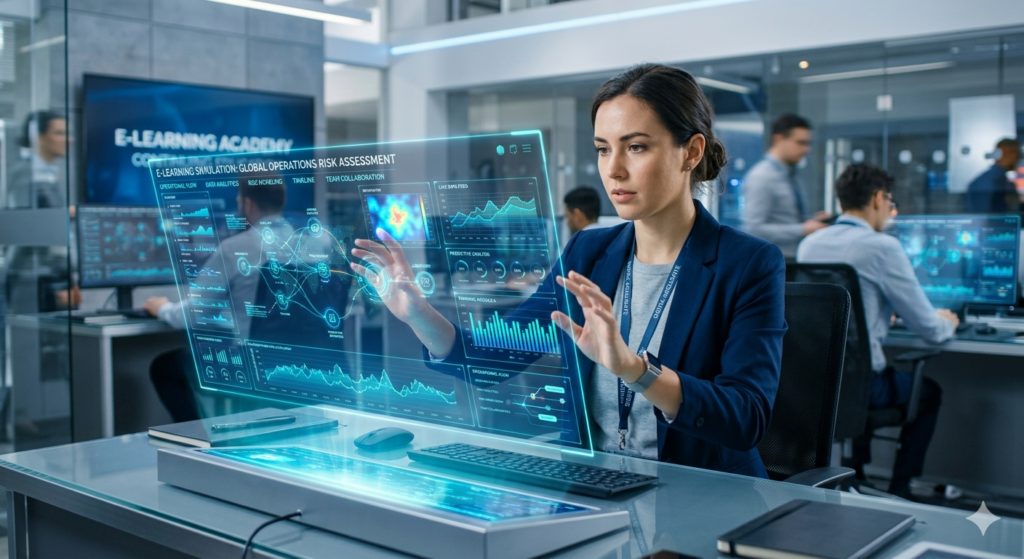
In today’s competitive learning landscape, simulation creation has emerged as one of the most powerful tools for delivering meaningful, practical education. Unlike traditional methods that rely solely on lectures or reading materials, simulations immerse learners in realistic, interactive environments that closely mirror real-world scenarios. This hands-on approach transforms passive learning into active experience, allowing individuals to apply theoretical knowledge in a safe, controlled setting. Firstly, scenario-based simulations enable learners to face genuine workplace challenges and make critical decisions without the risk of real-world consequences, building both confidence and competence. Moreover, interactive simulations dramatically improve knowledge retention; research consistently shows that learners who practice through simulation retain up to 75% more information compared to traditional training methods. Incorporating real-world environments into simulations ensures that the skills learned are directly transferable to actual job performance, reducing the learning curve significantly. Additionally, simulations can be tailored to specific industries — whether healthcare, IT, finance, or manufacturing — making the learning experience highly relevant and targeted. Tracking learner progress through built-in analytics allows organizations to identify skill gaps and optimize training programs for better outcomes. By integrating gamification elements such as points, badges, and leaderboards, simulations further boost learner motivation and engagement. Ultimately, simulation creation bridges the gap between classroom theory and real-world application, empowering learners to perform with greater skill, efficiency, and confidence from day one.